desıgn the future
Automated World
A pseudo-scientific experiment in randomness, automation, and belief.
11/12/20252 min read
The world is steadily moving toward autonomy.
Emails send themselves. Reminders appear before we forget. Content is scheduled, shared, optimized, and delivered without human intervention. More and more decisions are quietly delegated to automated systems.
A few months I spent living in the States made this even more visible. During that time, I bought Powerball tickets a few times. It was never about expectation or belief; it was something my brother and I enjoyed doing together like a hobby. A moment of shared curiosity.
But every time, the same question returned: Which numbers should we choose?
At first it felt trivial. Then repetitive and exhausting. Picking numbers felt less like chance and more like a burden.
That’s when the idea sparked in my mind. What if there was a website that chose the numbers for me?
Not a randomizer website or a “lucky number generator.” A website that justified the numbers by analysis.
From there, the question shifted. If humans insist on searching for meaning in randomness, why not let an automated system do the same?
That impulse became a part of the Automated World.
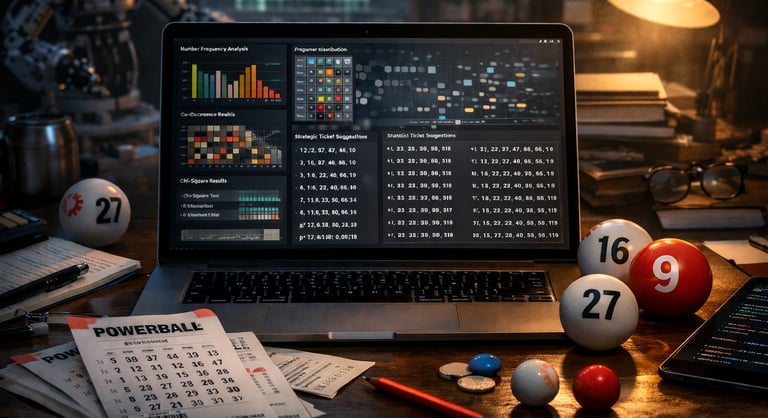
The system I built does exactly that. It collects nearly 28 years of historical Powerball data, processes it through a statistical engine, and uses AI to produce a structured weekly report along with 10 number combinations, each grounded in a different mathematical or probabilistic perspective. Frequency analysis, regression to the mean, pair correlations. Not predictions, only narratives built from the data it collected.
The system never claims to beat randomness. It ends every report by stating the mathematical truth: lottery draws are independent events, every combination has the same probability, and the expected value is negative.
Automated World is not about winning.
It is about delegation, belief, and the strange comfort of letting a system think for us—even when we know it changes nothing.
In a world increasingly shaped by autonomous decisions, this project is a small experiment:
What happens when we automate not certainty, but doubt itself?
At a technical level, Automated World - Powerball Analysis is built as a fully autonomous workflow using n8n. The system operates without manual input and follows a clear and repeatable logic.
The automation first collects historical Powerball draw data dating back to 1997. To ensure full coverage and avoid source limitations, the total time span is divided into smaller intervals and scraped incrementally. Each draw result is stored as raw numerical data, untouched by interpretation.
Once collected, the data is processed through a custom JavaScript-based statistical engine. This layer calculates number frequencies, identifies relative outliers (commonly referred to as hot and cold numbers), evaluates distribution balance, and detects number pairs that appear together more often than random expectation. The goal at this stage is not prediction, but structure.
The processed statistics are then passed to an AI agent powered by GPT-4o-mini, designed to act as an analytical narrator rather than a decision-maker. The AI generates a written report and produces 10 distinct number combinations, each based on a different mathematical perspective—such as entropy balance, regression to the mean, pair correlation, or short-term trend weighting.
Finally, the output is formatted into a clean, editorial-style HTML report and delivered automatically as a weekly email. The entire process—from data collection to delivery—runs autonomously.
Every report concludes with an explicit disclaimer: lottery draws are independent events, all combinations share equal probability, and no analytical method can overcome inherent randomness. The system does not hide this limitation; it is built around it.